






It’s one of those magical opportunities when brand and customer desires align, yet many companies don’t turn the trend into practice, leaving plenty of room for you to stand out. It’s called a personalized customer journey.
How New Store Credit Strategies are Cutting Merchants’ Losses
Sometimes, revenue loss prevention can feel like an impossible mission. You build a passionate team to develop, design and market the best products for that target audience you’ve dedicated your professional life to support. You invest in customer service to win all customer services. And, still, if you’re in ecommerce, you could find yourself part of the 64% that consider product returns a high or very high priority. Because it just keeps happening.
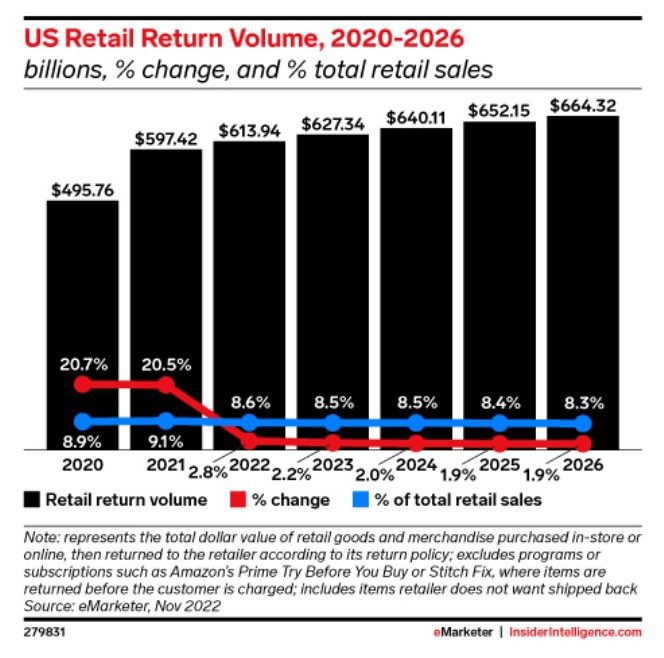
In an early 2023 report, eMarketer predicted a 2.2% growth in returns this year. It might not sound much, but considering that 30% of eCommerce products get returned according to some studies, this can feel overwhelming. If that’s not enough, eMarketer also predicts that “eCommerce returns will stay above pre-pandemic levels” at least until 2026.
But at Rise.ai, we’re not here to increase your overwhelm. We’re here to talk about how you can create a customer-friendly returns policy that also keeps your profits intact.
How Much Do Refunds Cost Merchants?
The number was $600 billion in 2015, according to Reuters. Yet…
Consumers are expected to return more than $816 billion worth of retail merchandise purchased in 2022, according to the National Retail Federation (NRF).
Ecommerce and offline return rates are pretty much the same for the first time in the 4 years NRF has conducted this study, it reports.
Let’s explore why consumers return so many products, then talk about revenue loss prevention strategies you can implement in your returns policy.
Main Reasons for Product Returns
Here are some of the most common reasons consumers return products. It’s important to understand them before you start to build or change your revenue loss prevention program.
Replacing Damaged Goods: Costing Up to 17x the Original Shipping Price
Over 4% of merchants’ revenue loss comes from returned products that can’t be sold again, or can only be sold at a lower price, reports Amcor.
If merchants replace a damaged goods product, the overall cost can go up to 17x the original shipping price, it adds.
Inaccurate Expectations are Everyone’s Fault
Buying products online might feel as easy as clicking a button, but it’s just as easy to get the wrong impression of a product, including size, colors & more.
Some of it happens because of customers’ rush. Maybe they don’t do full on research, email in with questions, or even simply read a product’s description.
But some of it is on merchants, who need to go the extra mile, to do everything they can to set realistic expectations. We’ll give you an example of it in a bit, when we talk about the revenue loss prevention solutions merchants have found.
63% of Consumers Buy with the Intention to Return Most of Their Purchases
If you’ve ever bought clothes, online or off, you know that finding your size isn’t that easy. You’re one size with this brand, another size with that brand. If you’re buying for others, it’s probably even more challenging to find the right size. Similarly, if you’re in the midst of a home decor project, you might not be sure which item or color will work best with your current vision.
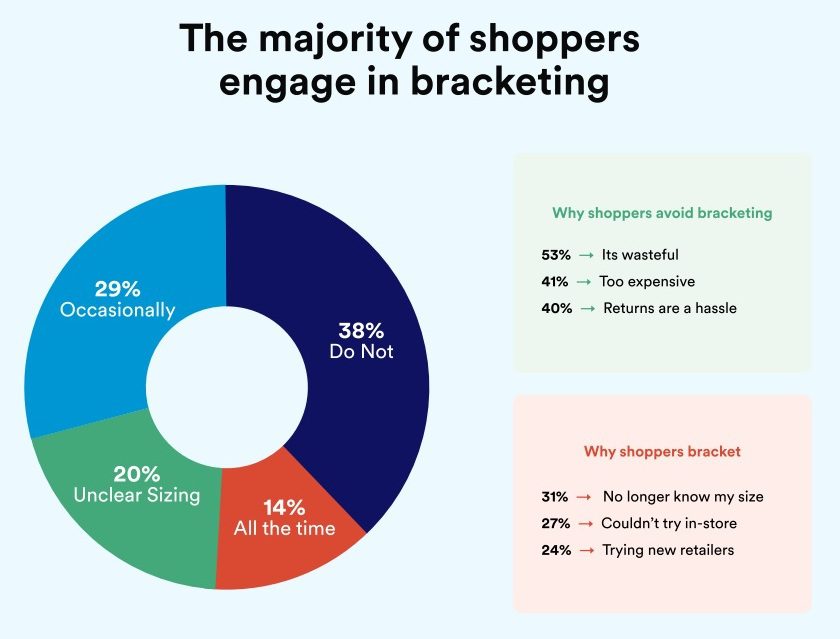
So you bracket – you buy the same item in different sizes or colors, with the intention to hopefully use one and return the rest.
And you’re not alone.
In a 2022 survey, 63% of consumers reported doing this, according to Business Insider.
77% of Consumers Plan to Return Gifts – and that’s Just During the Holidays
Getting gifts isn’t as easy as it sounds either. People might give you unnecessary items, stuff that doesn’t fit your style, something you already received for that same occasion, or a product you just bought for yourself.
It’s no surprise, then, that…
Merchants Lose $10 for Every $100 Worth of Returned Products
Remember we said that “damaged goods” is a popular reason for returns, and you have to take it into consideration when designing your revenue loss prevention program? Some products are indeed damaged in the manufacturing or shipping process. That’s part of life. However, apparently, when companies review the products, many more turn out reusable than damaged.
Maybe you can find some consumer innocence here. Maybe a product is reusable even though there’s an issue with it. But there are others that return forgeries – or items that have been used (for example, worn) and damaged by consumers themselves.
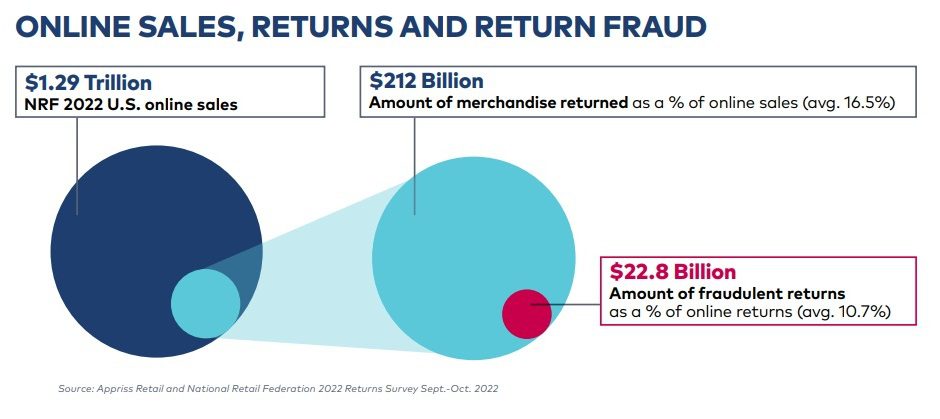
The problem is so profound that “for every $100 in returned merchandise accepted, retailers lose $10.40 to return fraud,” according to the late 2022 report by the National Retail Federation and Appriss Retail mentioned above.
Merchants’ Returns and Refunds Policy: Strategies to Try Out
As promised, here are some strategies that merchants use, and you can try out, too.
Provide Refunds and Let Consumers Keep Their Products
As discussed above, processing returned products can get expensive. Therefore, some companies initiated a “get a refund, keep the product” returns policy. In a discussion on RetailWire, some thought it made a perfect mathematical solution, while others were concerned consumers would abuse this refunds policy.
However…
- Some of the commenters pointed out that it’s very easy to recognize those who take advantage, and you can fight it, in part, by limiting the number of times each consumer can enjoy this policy.
- Another commenter suggested getting consumers through a returns process anyway – just have them send the products to a nonprofit instead of back to your company.
Regarding this latter idea, Rise.ai recommends choosing a nonprofit ahead of time and discussing with them what’s OK to send over and what isn’t. The last thing you want to do is add unnecessary work to organizations that are likely under budgeted and understaffed, as they try to save the world.
Encourage Consumers to Resell Your Products
Not only do product returns cost merchants a fortune, they cost the environment, too.
With 85% of consumers now considering the environment in their purchases, encouraging consumers to resell your products instead of returning them is a win-win-win. To make it happen in your business:
- You can promote this idea in your messaging across your website, email list and social media.
- Aim to build a community around your brand by showcasing user generated content from consumers who have done that, and maybe found new, like minded friends along the way.
- Use a platform that helps you build a second hand site for consumers to offer or ask for products from your company at a lower cost than what’s found on your original store. Treet, a Rise.ai partner, for example, creates branded peer to peer marketplaces, where consumers resell and buy a company’s products in exchange for either cash or store credit.
Be More Generous with Time in Your Return Policy
A third of merchants now offer more than 45 days to finish the returning process. That number increased from 28% in 2021 to 33% in 2022, reports Narvar. It’s “a sign that retailers believe more generous, flexible return policies are crucial to increasing sales volume,” it says.
Want to go the extra mile? Send consumers follow ups on when their returns window is closing.
Look at Product Returns as an Opportunity to Win Consumers’ Hearts Long Term
You can minimize returns, but you can’t eliminate them entirely. They’re part of doing business. But it doesn’t have to be a bad thing. Check out these findings:
You can minimize returns, but you can’t eliminate them entirely. They’re part of doing business. But it doesn’t have to be a bad thing. Check out these findings:
96% would buy from your business again if they have “a good returns experience.”
74% will likely buy one product while returning another.

In other words, to ensure revenue loss prevention, focus on providing an excellent returns experience. This can include:
- Empathy from company representatives.
- Flexibility regarding when and where consumers can return a product.
- A non-salesy incentive to give your business another try. This can be done via store credit refunds or automation of custom triggers (more on that later in the article), to give you a couple of examples.
And there’s more. Check out these great channels to include in your returns policy:
Optimal Channels for Managing Returns for Revenue Loss Prevention
Product returns can become one of your company’s best consumer preservation tools. Let’s explore this further.
In-Store Replacement or Shipping Replacement
In a way, in-store replacement makes the most sense, especially considering the stat above. You’d think that, if consumers are already at your store, they might find something they like and buy that. Hey, maybe it’ll be even more expensive than the item they’re returning.
However, our returns policy can’t be just about what’s best for us. It has to make sense for our businesses, but if we don’t align that with what’s best for our consumers, we’re in trouble.
Therefore, whenever possible:
- Let consumers return products however they please, and
- Provide an outstanding experience, whether they do so face to face or via the post office.
That said, keep track of your data to discover what’s most efficient and cost-effective for you. There’s nothing wrong with providing an incentive for consumers who return products in a way that makes your business healthier, just as long as you keep other options open for different types of consumers.

Store Credit Refunds, Cashbacks and Points
Just because one product wasn’t a good fit doesn’t necessarily make the rest of your store irrelevant to a specific consumer. One way to convince consumers to give you a second chance at such a sensitive time, as a request for a refund, is to offer a gift. The gift could be:
Cashback on their next purchase
Cashback is basically “free money” that consumers get to their account once they make a purchase. It could be enticing, but it doesn’t prioritize long term relationships with your specific brand. It’s important to design a long term revenue loss prevention program, so the gift you offer needs to be tied to your brand.
Earned points
When consumers gain points with your company, they can gradually use them to get bigger and bigger rewards. The more they buy, the more points they accumulate. When you provide a refund, you can add points as an act of goodwill and consumer preservation. If they didn’t consider shopping around post-refund, maybe now they will. But if you want to make it even easier for consumers, consider store credit refunds.
Store credit refunds
These are a win-win for consumers and merchants alike. When you offer the option to get a refund in store credit, otherwise known as “brand currency”, consumers tend to use it right away.
Offer a bigger refund using this method than you do in standard refunds (for example, if they bought a $60 product, refund $75 in store credit), and consumers are likely to take you up on your offer.
At Rise.ai we personally saw one of our merchants, Dottie Couture, a women’s apparel and accessory boutique, reduce return costs by 42% within two months of using store credit refunds. How? Their consumers bought 300% more with the store credit refunds than the value of their first purchase.
Set Post-Purchase Custom Triggers to Reengage Customers
One of the little talked about customer retention strategies is to personalize their experience, even in the context of operating a returns workflow. In an interview with Narvar, Rise.ai’s chief revenue officer, Tom Reiss, talked about how, once you segment and personalize your message, you can set custom triggers that…
- Target people who just took action on your site – say, bought a product.
- Encourage them to take action – say, you delay the message by a few days after one’s purchase, then offer a very quick opportunity to buy again with a special offer, store credit, etc.
As Rise.ai previously reported, the more times consumers buy from you…
- The more they’ll keep buying from you.
- The fewer products they’ll ask to rerun.
- Even if consumers end up needing a refund, it likely won’t keep them from buying from you again, given that they already bought multiple times – and presumably, had a good experience, or they would have stopped.
If you’re on the Shopify app (and even if you’re not), get a platform like Narvar, Loop (where Rise.ai has also partnered up) and Returnley. There are other options, of course, but these are the best the team at Rise.ai has found.
Start Your Revenue Loss Prevention Program with Empowered Returns Policy and Strategies
Like we said, product returns are a part of doing business. There’s no way to avoid them, yet there are many ways to turn them into long term preservation opportunities. Store credit refunds, custom triggers… you name it.
For the next quarter, choose one strategy or tool to try out. Set goals and make a proactive plan with your team. Test it out. Optimize it. You’ll be able to see whether it works for your specific consumers and business, whether you need to tweak it, or let it go entirely. Once you have a strategy or tool that works for you, add another one, and optimize that one too. Gradually, you might find yourself looking forward to returns, because you’ll know it’s the most unexpected place to delight customers and win them for life.